
The private texts Jesse Watters keeps turning into television moments: Why his on-air exchanges with his mother keep fascinating — and dividing — viewers
For years, one of the most unexpected recurring characters in Jesse Watters’s television world has not been a political rival, a guest commentator, or even a fellow host.
It has been his mother.
More specifically, it has been the messages she sends him — often sharp, often critical, and sometimes delivered with the kind of blunt honesty that instantly captures audience attention.


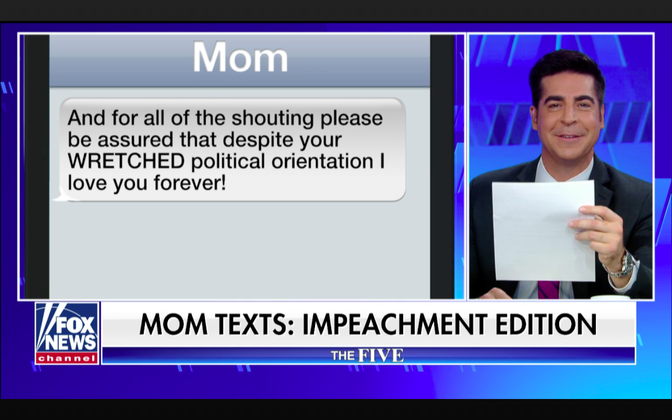
Again and again, Watters has turned private family communication into live television material, reading aloud text messages or recounting phone conversations with his mother, Anne Purvis, in moments that regularly leave viewers amused, surprised, and sometimes deeply divided.
What makes those exchanges especially compelling is the political contrast at the center of them.
While Jesse Watters has built his career as one of the most recognizable conservative voices on cable television, his mother is widely understood to hold far more progressive political views, often positioned firmly on the Democratic side of the ideological divide.
That contrast has created one of the most unusual recurring dynamics in political television: a son known for aggressive conservative commentary publicly acknowledging that one of his most persistent critics may be sitting at home watching every word he says — and texting immediately when she disapproves.
In several well-known on-air moments, Watters has openly admitted that his mother does not hesitate to challenge him when she believes he has gone too far.
Sometimes the criticism arrives as a short text.
Sometimes as a longer reaction after a segment airs.
Sometimes, according to Watters himself, through direct calls in which she questions his tone, his language, or the way he framed a political issue.
That recurring image — a nationally known host receiving corrective messages from his own mother after a live broadcast — has become strangely irresistible to viewers because it cuts through the larger political persona and reveals something more personal. 📱
The exchanges often introduce a rare softness into a public image otherwise built around confrontation.
Because on screen, Watters is known for certainty.
His tone is sharp, fast and often intentionally provocative.
But when speaking about his mother, another tone emerges: amused, slightly defensive, occasionally affectionate, and clearly aware that family criticism carries a different weight than public backlash.
The political divide itself only deepens public fascination.
Anne Purvis has repeatedly been described as someone who does not share her son’s ideological instincts and who watches his commentary with an eye not of admiration, but of concern when she feels rhetoric crosses a line.
That means some of the most memorable criticism Watters receives does not come from political opponents online — it comes from inside his own family.
For many viewers, that creates an almost symbolic image of modern America: one household, two sharply different political worlds, connected by family but divided by worldview.
And yet that same dynamic also raises another question — one that appears every time Watters shares those messages publicly:
How private should family disagreement remain?
Critics argue that repeatedly turning a parent’s texts or phone calls into broadcast content risks blurring boundaries that many families would prefer to keep intact.
A mother may text her son privately expecting personal reflection, they argue, not national exposure.
Even when the tone is humorous, the act of bringing those messages onto television invites millions into what began as a personal exchange.
That concern becomes sharper because Watters often presents the messages in a way that enhances their contrast: the conservative son, the liberal mother, the ideological correction arriving almost on cue after controversial commentary.
For supporters, however, that is precisely why the moments work.
They see them as humanizing rather than invasive.
Instead of projecting an untouchable political identity, Watters appears willing to show that disagreement exists even at home — and that political difference does not necessarily destroy family connection.
In that reading, Anne Purvis becomes less a private figure exposed unwillingly and more a symbolic reminder that political debate is not confined to studios, campaigns or elections.
It lives inside kitchens, family chats and ordinary conversations.
That may explain why these moments continue to resonate.
They reveal that even highly visible political figures do not escape domestic accountability.
No matter how forceful the on-air segment, somewhere afterward there may be a text waiting.
And often, according to Watters, that text is not subtle.
Some viewers laugh because the messages sound familiar — many families now live versions of the same tension, where politics enters conversations between parents and children in ways previous generations rarely experienced so intensely.
Others see discomfort in the public retelling, particularly when private criticism becomes recurring entertainment.
The broader issue reflects a larger cultural shift:
Modern media increasingly rewards moments that collapse the distance between public and private life.
A host no longer simply delivers commentary; he also shares family reaction, personal routines and private response loops that once would have remained off screen.
That blending makes political figures appear more relatable — but also more exposed.
For Watters, the choice to repeatedly mention his mother’s criticism appears intentional.
It softens his image without changing his politics.
It shows that even strong ideological confidence exists alongside someone close enough to challenge him directly.
And perhaps most importantly, it creates narrative tension viewers instantly understand:
A conservative television star finishing a segment… then hearing from a Democratic mother who has been watching every minute. 📺
That image is simple, but powerful.
Because it reminds audiences that political identity may dominate television, but family identity remains harder to control.
Whatever viewers think of Jesse Watters’ commentary, the continuing presence of his mother’s voice — even through text messages — suggests that outside the studio, no public persona is ever entirely insulated.
Not from critics.
And certainly not from family. ✨📰


